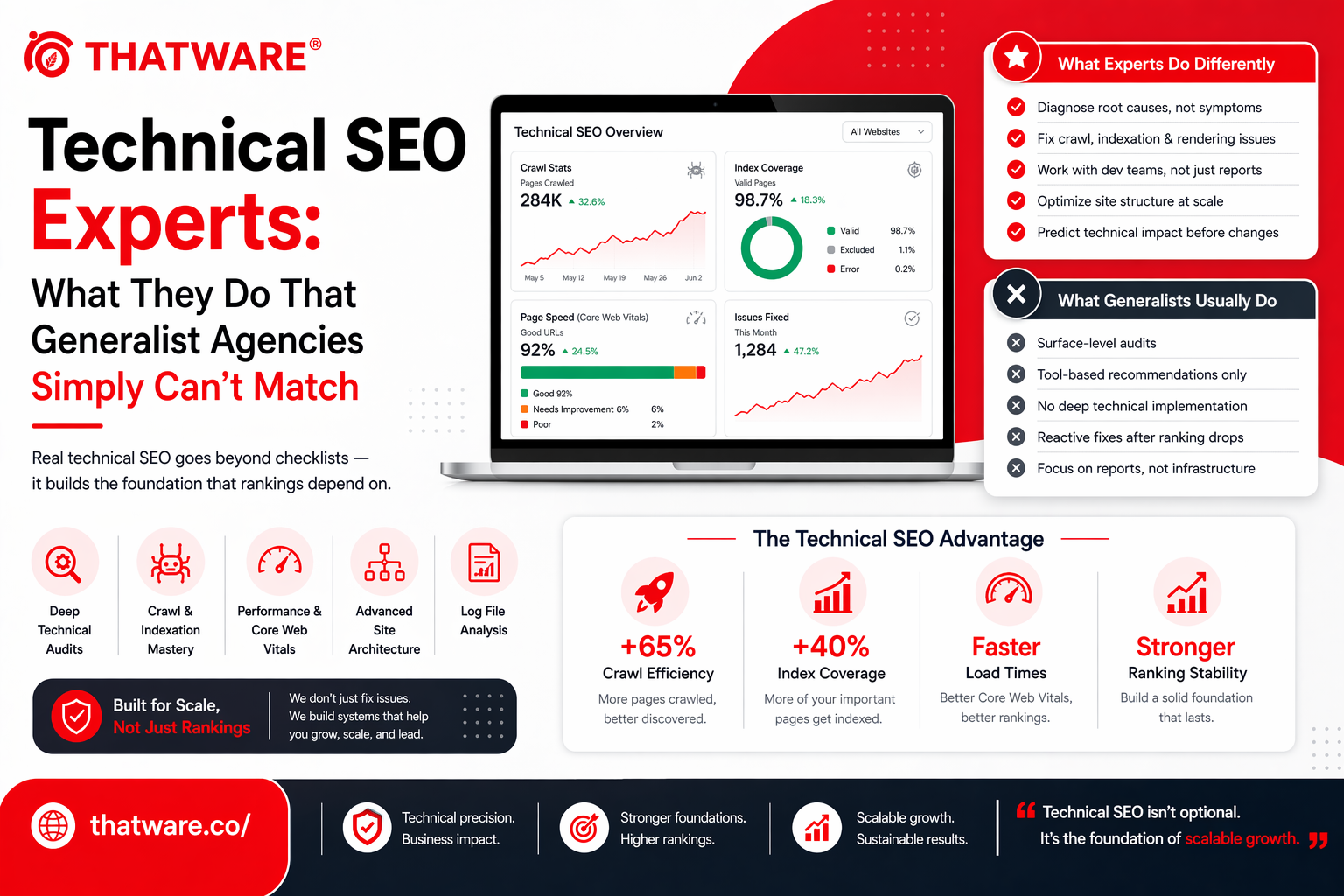
Most SEO agencies have technical SEO on their service menu. Audits, fixes, recommendations. Some of them do this work adequately. A smaller number do it with genuine depth. And then there’s a category of practitioner that could reasonably be called a technical SEO expert, someone whose primary professional focus is the technical dimension of how search engines interact with websites, and who has accumulated the kind of specialized knowledge that generalist agencies simply don’t have.
The difference shows up clearly when the technical problems are complex.
Basic technical SEO problems are well-documented. Broken links, missing meta tags, duplicate content from URL parameters, slow page speed, missing structured data. Good SEO tools surface these automatically. A competent generalist agency can audit and fix them. This category of work doesn’t require specialization.
The problems that require genuine technical expertise are different. JavaScript-heavy sites where Googlebot’s rendering behavior differs from browser rendering, and where understanding how to audit and fix that gap requires deep knowledge of how Google’s rendering infrastructure actually works. Faceted navigation on large e-commerce sites, where the interplay between crawl budget, canonical signals, and URL parameter handling requires the kind of nuanced decision-making that comes from having seen similar problems across many sites. Log file analysis at enterprise scale, where identifying meaningful crawl behavior patterns in hundreds of millions of log entries requires both the right tooling and the analytical experience to know what to look for.
International SEO at scale is another area where specialist depth matters enormously. Hreflang at hundreds or thousands of URLs, structured correctly, validated, and maintained, while managing the interaction with other international signals like ccTLDs, subdomains, and geo-targeting settings, and doing all of this for a site that may have multiple regional teams making content decisions. The number of things that can go wrong here and the subtlety of diagnosing them correctly is substantial.
Core Web Vitals for complex sites involves a different level of technical depth than running Lighthouse on a simple page. Understanding how third-party scripts interact with LCP, how layout shift is generated by specific ad implementations, how INP is affected by main-thread blocking from tracking tags, and how to address these issues without breaking the business functionality they support, this is specialist work.
Technical seo experts in the genuine sense have typically developed their expertise through years of focusing specifically on these kinds of problems. They’ve seen the patterns. They know which diagnostic steps reveal which root causes. They know which fixes address symptoms versus causes. And they know when a problem that looks technical is actually a content strategy or UX problem in disguise.
For businesses running complex sites, the ROI of genuine technical expertise is significant. A technically flawed enterprise site may be losing 20 to 30 percent of its potential organic performance to crawl, indexation, and rendering issues that a technical specialist can identify and fix. That’s a recoverable value that a generalist agency running the same standard audit may not surface.
Working with a team offering genuine advanced seo services means the technical audit goes deeper, the recommendations are more specific and better prioritized, and the implementation guidance accounts for the actual technical environment of the site rather than generic best practice advice. For sites where technical complexity is a meaningful constraint on performance, that specificity is worth paying for.
How do you identify genuine technical depth in an agency or practitioner? Ask them about a technically complex problem they’ve solved recently. Not the problem type, but the specific problem: what the site was, what the symptom was, what the diagnosis process looked like, what the root cause turned out to be, and what the fix was. Genuine technical expertise produces specific, detailed answers. Marketing capability produces confident generalities.